
 The Arch-preceptory of Alden-Biesen
Belgium, province of Limburg, approximately 20 km south-east of Hasselt and approximately 15 km west of Maastricht (NL), municipality of Bilzen.
The Arch-preceptory of Alden-Biesen
Belgium, province of Limburg, approximately 20 km south-east of Hasselt and approximately 15 km west of Maastricht (NL), municipality of Bilzen.
The origins of the Teutonic Commandery of Alden Biesen date back to 1220, when Count Arnoul III of Looz(1) and his sister Mechtildis van Are, Abbess of Munsterbilzen(2) donate a pilgrimage chapel in Rijkhoven to the Teutonic Order. The name Alden Biesen comes from a distinctive feature of the area, where large quantities of rushes (Biezen in Dutch) grew. Alden Biesen means "Old Rushes".
It is here that the knights built their commandery. The donation of 1220 is followed by many others, and Alden Biesen becomes the main seat of the province of Biesen, which over the centuries would include up to twelve commanderies(3) located in the Meuse and Rhine regions.
Each of these enjoyed revenues that were initially used to support the Order's fight in the Holy Land, but later also for the conquest of Prussia.
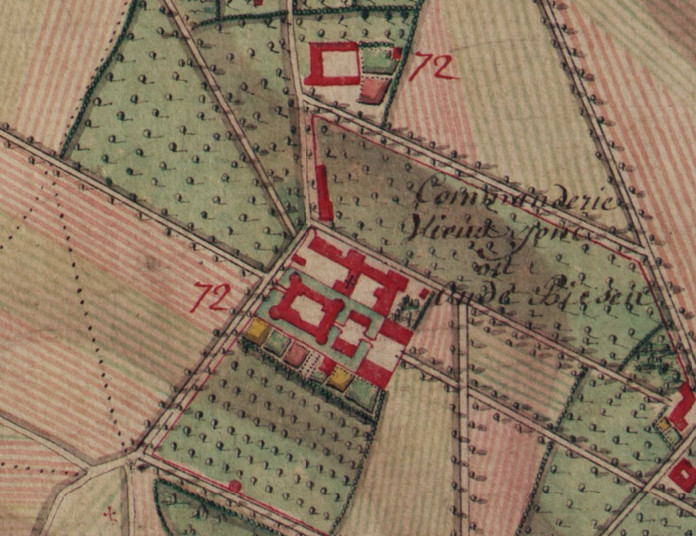
In the mid-16th century, Grand Commander Winand von Breil(4), undertakes the reconstruction of a majestic residence on the ruined estate.
The construction of the castle itself is completed in 1566 with the finishing of the great tower.
At the end of the 16th century, Commander Heinrich von Reuschenberg(5) initiates a policy of religious education to counter the Reformation. In particular, he creates scholarships at the University of Cologne and the Jesuit College in Maastricht. His successor, Edmond Huyn van Amstenraedt(6) , continues this project and creats a Teutonic college at the University of Leuven. These institutions become places of recruitment for civil servants and priests of the Teutonic Order for the region and beyond.
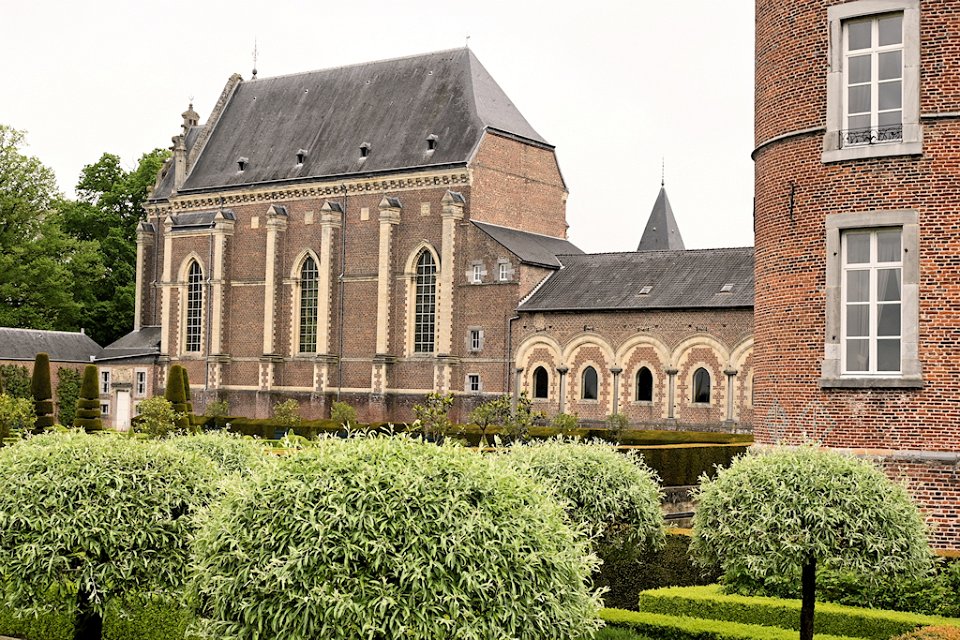
In the 17th century, while Calvinism is spreading throughout the Utrecht region, Alden Biesen remains a Catholic stronghold thanks to the actions of these two Teutonic commanders. The medieval chapel is transformed into a Baroque-style church. A gallery with a colonnade is added to the chapel. This gallery is intended to be part of a new hospice for travellers, but it will never be completed.
At the beginning of the 18th century, the French garden and orangery are laid out by Grand Commander Hendrik van Wassenaar(7). He also begins work on modernising the castle and have many of its rooms redesigned to bring it into line with the fashions of the day.
All the successive Grand Commanders will do the same, transforming the castle according to their whims. The last major renovation takes place in 1786-1787, when Grand Commander Franz von Reischach(8) have an imposing English-style park laid out, featuring monumental trees, exotic shrubs and bushes, fountains and water features, a replica of a Roman temple, a grotto, a hermitage, a Chinese temple and many other follies of that kind.
After surviving the two world wars with more or less damage, a huge fire ravages the castle in 1971. Owned by the state since then, the castle will be completely renovated. Transferred to the Flemish region with the federalisation of Belgium, it is adapted for use as a conference centre and now houses a permanent exhibition on the history of the Teutonic Order.
(1)Arnoul III is Count of Rieneck (Bavaria) from 1216 to 1221 and Count of Looz from 1218 to 1221. He is son of Gerard II, Count of Looz and of Adélaïde of Gelderland. He dies without issue in 1221. The County of Looz was located in the area which is nowadays the Belgian province of Limburg.
(2)Munsterbilzen is a small village located near the Preceptory of Biesen. During the 7th century, St. Landrada founds there an abbey for Benedictine nuns. Ida of Ardennes, mother of Godfrey of Bouillon and Baldwin, first king of Jerusalem, will receive there her education. The abbey is an imperial domain, and the abbess, princess of the Holy Empire, is sovereign on her lands.
(3)These preceptories were : Gemert near Bois-le-Duc ('s-Hertogenbosch); Siersdorf, in the Duchy of Jülich (around 25km north from Aachen); Bernissem, near Sint-Truiden; Jonge Biesen, in Köln (16th century) ; Bekkevoort, near Diest; Gruitrode, near Bree; Fouron-Saint-Pierre; Saint-Aegidius or Saint-Gilles, in Aachen; Ordingen, near Sint-Truiden; Ramersdorf, in a suburb of Bonn; Saint-Andreas in Liège and Nieuwen Biesen near Maastricht.
(4)Winand Breil or von Breiel is Great Preceptor of Alden Biesen from 1536 to 1554. He is also preceptor for the provinces af Friesland, Groningen and Overijssel. He dies on January 5th 1554.
(5)Heinrich von Reuschenberg comes from a high noble family of the German Empire. He is born in 1528 in the castle of Setterich, on the territory of the city of Baesweiler (20km from Aachen). He enters the Teutonic Order in 1547. He first occupies a secondary place in the preceptory of Maastrichtbefore becoming Preceptor of Ramersdorf in 1551. He becomes also preceptor of several other preceptories in the area before being elected as Grand Preceptor of Alden Biesen in 1577. He occupies this position until his death in 1603.
(6)Edmond Huyn von Amstenraedt is Grand Preceptor of Alden-Biesen from 1605 to 1634. He succeeds Willem Frambach Bock von Lichtenberg, who was in this position only for two years, from 1603 to 1605. Edmond Huyn von Amstenraedt is also the nephew of Heinrich von Reuschenberg.
(7)Hendrik van Wassenaer tot Warmond is Grand Preceptor of Alden-Biesen from 1690 to 1707.
(8)Franz Johan von Reischach is the last Grand Preceptor of Alden-Biesen. He holds this position from 1784 to 1794, time when the Teutonic knights are expelled from the "domain" because of popular riots due to the French Revolution.


Templiers.org - Christophe Staf
All Rights Reserved
Member of the Templars Heritage Route - Route du Patrimoine Templier