The Masters of the Teutonic Order : Anno von Sangerhausen (o12?? - 1273+)
Masters of the Teutonic Order from 1256 to 1273
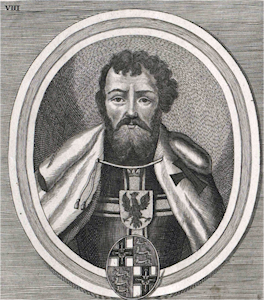
Source : Poczet Wielkich Mistrzów Krzyzackich
Like Heinrich von Tunna, Herman von Salza and Gunter von Wüllersleben, Anno von Sangerhausen came from a family of stewards to the Landgrave of Thuringia, for whom the town of Sangerhausen was probably the principal estate.
Almost nothing is known about his family, although Jutta von Sangerhausen(1), venerated as the Angel of Chełmża, was his relative.
Anno suddenly appeared in the history of the Teutonic Order in 1254 as Grand Master of the Province of Livonia(2). The Teutonic Order’s estates then stretched along the Baltic Sea, extending from Pomerania to Livonia. The Lithuanians were at peace with the Order, and on the banks of the Niemen, the new fortress of Klaipėda was being built.

Source : Wikipédia
Anno von Sangerhausen played a significant role in the construction of this fortress, and when it came under attack from the Samogitians(3), he rushed to its defence and brutally subdued the entire region of Samogitia.
In June 1256, Anno was required to travel to Rome to take part in the General Chapter convened by Grand Master Poppo von Osternohe, who, under circumstances that remain unclear to this day, resigned from his post. Shortly afterwards, probably whilst the chapter was being held in Sachsenhausen, Anno Sangerhausen was elected the new Grand Master of the Teutonic Order.
After a few years of relative peace, the Samogitians, backed by the Lithuanian king Mindaugas(4), attacked Livonia. In September 1260 in Prussia, a major revolt by all the tribes broke out against the Order, and Alexander Nevsky(5), Prince of Novgorod, set out from Pskov to lay siege to Dorpat. All the peoples oppressed by the Teutonic Knights rose up against them, and the Order nearly vanished under this onslaught. It lost most of its castles, retaining only those situated along the rivers and on the banks of the Vistula estuary.
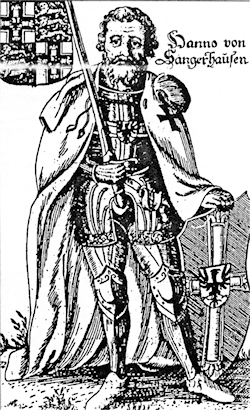
Source : Poczet Wielkich Mistrzów Krzyzackich
To save the Order from imminent destruction, Anno von Sangerhausen embarked on a major diplomatic campaign across Europe, and particularly at the papal court, where he succeeded in persuading Pope Urban IV to summon the Crusaders from all over Central Europe. The Pope asked them to lend their aid in the fight against the pagans of the north and even recommended granting absolution to all those who had committed crimes in their own countries if they went to help the Teutonic Knights. Thanks to this appeal, Anno was able to rush to Prussia in January 1263 with a large force of knights, mainly from the Rhineland.
Following this initial success, Anno began recruiting throughout Europe, but particularly in Germany: in his native Thuringia, in Brandenburg, in Franconia amongst the princes of Brunswick, and in Altenburg, Marburg, Eger, and Regensburg. He even travelled to Bohemia and Austria, and it was undoubtedly thanks to all this energy that new knights were constantly arriving in Prussia.
Another result of his efforts was the establishment of 16 new commanderies across Europe, such as in Venice, San Leonardo, Möttling and Eger, from which the Order drew considerable funds for its activities in the East.
When, in 1265, Pope Clément IV once again sought assistance for the Teutonic Order, even Albert II, Prince of Brunswick(6), Albert II, Landgrave of Thuringia(7), and Otto III, Margrave of Brandenburg(8), came to his aid. But it was the expedition led by Margrave Dytryk II(9), which ravaged Natangia(10), that dealt the most severe blow to the Prussian tribes in 1272.
From that moment on, the Teutonic Knights began to reclaim the territory they had previously lost, recaptured the fortress of Lidzbark and pushed the resistance back beyond the borders of the Teutonic State.
Anno von Sangerhausen died on 7 or 8 July 1273 in Germany without living to see the Order’s ultimate triumph. Neither the exact place of her death nor her burial site is known. Some chroniclers suggest that she may be buried in Trier or Mergentheim.